

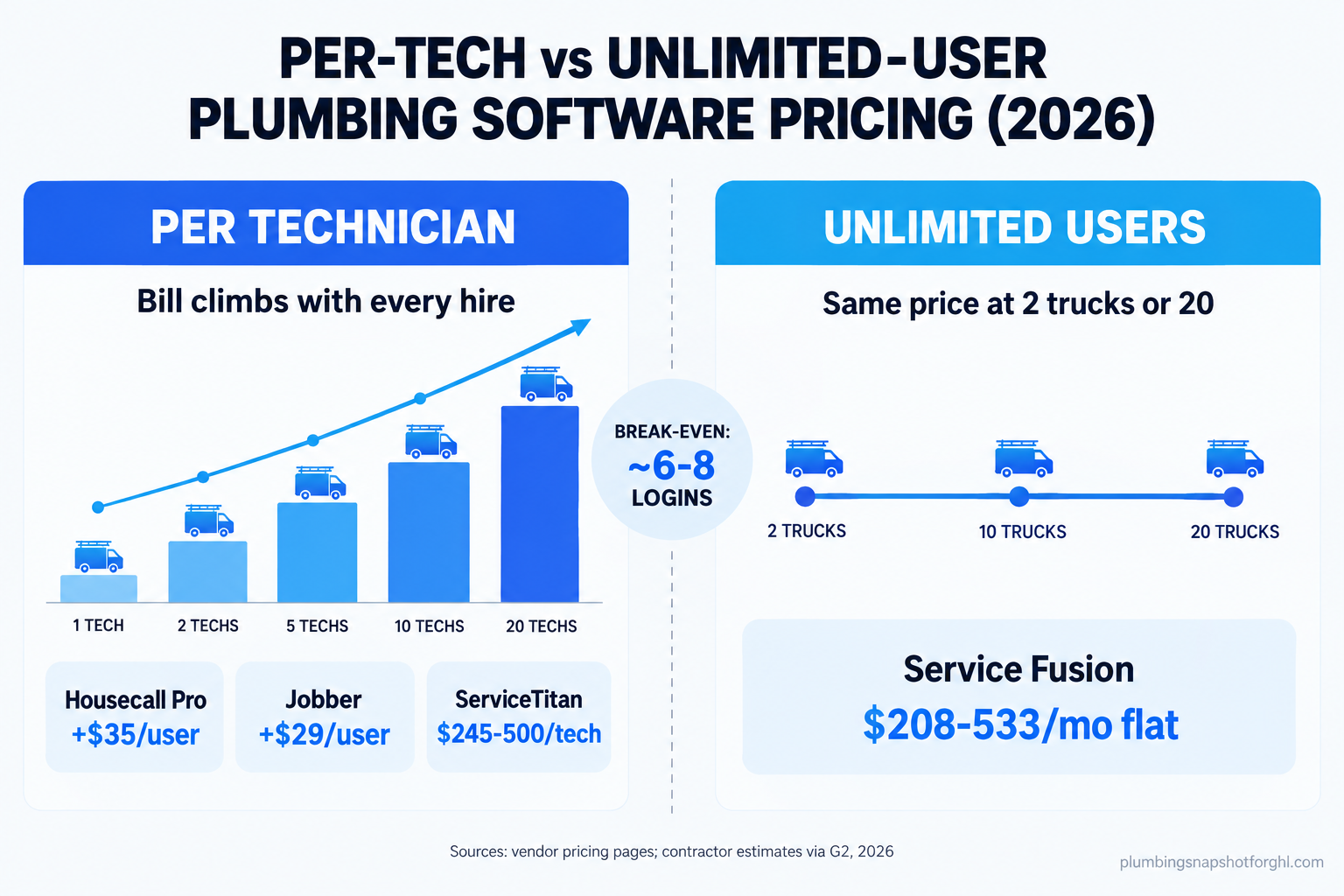
You just hired your fifth tech. Good problem to have. Then the software invoice hits and it’s $35 higher than last month, and it hits again when tech number six starts, and you realize the tool you bought to help you grow charges you a fee every single time you grow. The reason is the pricing model, not the tool. Plumbing software charges one of two ways: per technician (a fee for every seat, so the bill climbs with your crew) or a flat rate for unlimited users (the same price at two trucks or twenty). For most shops the break-even sits around six to eight logins, roughly six to ten trucks. Below that, per-seat wins. Above it, flat unlimited wins and the gap widens with every hire. This post shows the real 2026 numbers and the math to find your own break-even.
In this guide
- The two ways plumbing software charges you
- What per-seat pricing actually costs
- What flat unlimited-user pricing costs
- The break-even truck count
- Run it for your shop: solo, mid, and large
- How each pricing model breaks
- Steal this: force a real quote and find your break-even
- Objections, answered straight
- The cost none of these prices covers
- Frequently asked questions
The two ways plumbing software charges you
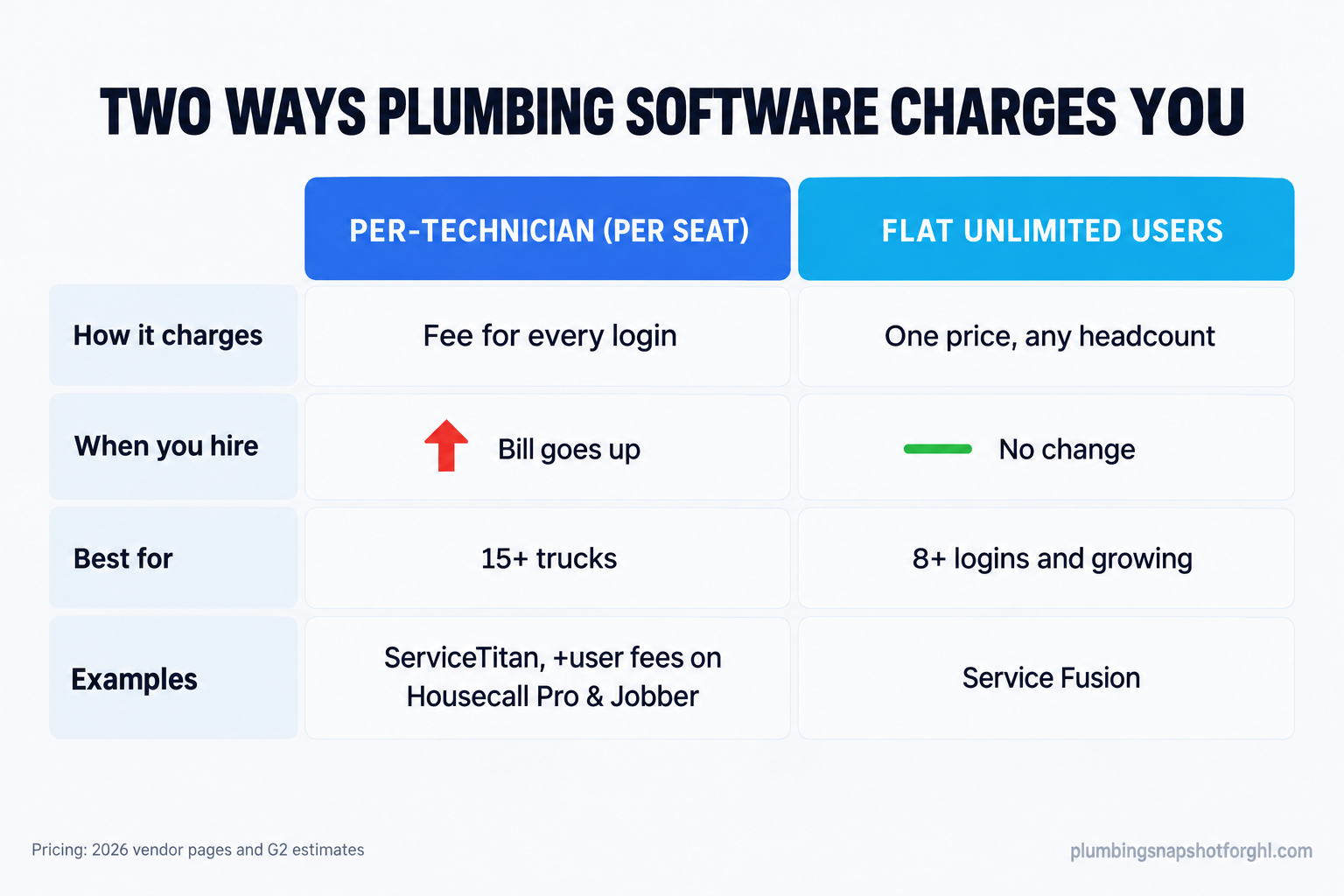
Strip away the tier names and the feature lists and every field-service tool bills you one of two ways.
Per seat (per technician, per user). You pay a fee for every person who logs in. ServiceTitan is the clearest example: the whole model is per technician (ServiceTitan pricing). Housecall Pro and Jobber are hybrids that sell a base plan with a set number of users, then charge extra for every login past the cap. The defining trait: your bill goes up when you hire.
Flat rate (unlimited users). You pay one price and add as many logins as you want. Service Fusion is built this way (via G2). Your second tech and your twentieth cost the same in seat fees, which is nothing.
Neither model is better in the abstract. Which one wins depends entirely on how many logins your shop needs, and that number is bigger than most owners think. A login isn’t just a truck. It’s every field tech plus everyone in the office who touches a job: the dispatcher, the CSR, the bookkeeper. A 6-truck shop often needs 8 or 9 logins. Count them honestly before you price anything, because the seat count is the whole ballgame.
What per-seat pricing actually costs
Here are the real 2026 numbers for the tools most residential shops weigh.
Housecall Pro publishes its prices, which makes the seat tax easy to see. Basic is $59/month annual for one user, Essentials is $149/month annual for up to 5 users, and Max is $299/month annual for 8 users, then $35/month for every additional user (Housecall Pro pricing). The plan looks flat until you cross the user cap, then it turns into a per-seat tool.
Jobber works the same way with a smaller increment. Core starts at $49/month for one user, and every plan adds seats at $29/month per user (Jobber pricing). Jobber also prices several things plumbers want, like its Marketing Suite and an AI Receptionist add-on, as separate line items.
ServiceTitan is the pure version of the model. It doesn’t publish prices, but the structure is per technician, and contractor estimates cluster around $245 to $500 per technician per month (estimates via G2), usually on an annual contract with a large setup fee. There’s no base-plan cushion. Every seat is a full seat, and the meter runs from tech one.
These share one trait: the cost curve bends upward as you grow. Watch what Housecall Pro Max does once you pass its 8-user cap.
Housecall Pro Max monthly cost on annual billing: $299 base (8 users included) plus $35 for each additional user. A flat unlimited-user plan would be a straight horizontal line across all five points. Source: Housecall Pro pricing.
The line only goes one direction. Every truck you add to grow the business quietly raises your fixed overhead.
What flat unlimited-user pricing costs
Now the other model. Service Fusion charges a flat rate for unlimited users across its three tiers, reported at roughly $208 (Starter), $325 (Plus), and $533 (Pro) per month on annual billing, with no long-term contract (via G2). Add your second tech, your eighth, your fifteenth: the seat fee is the same, zero. On the chart above, Service Fusion is a flat horizontal line at $208 while the per-seat plan marches up past $700.
Sources: Housecall Pro, Jobber, Service Fusion via G2. ServiceTitan does not publish prices.
Here’s the honest catch: “unlimited users” is a headline, not the whole invoice. Flat-rate tools still charge for the extras that sit outside the seat: GPS fleet tracking runs roughly $25 to $40 per vehicle per month, phone and AI answering are priced separately, and card processing is its own per-transaction rate. Service Fusion also tends to quote through a sales call rather than a public price page. Unlimited seats does not mean unlimited everything, so confirm your tier and add-ons before you sign.
The break-even truck count
Put the two models on the same shop and the crossover appears fast. At a low seat count, per-seat wins clean. Housecall Pro Essentials is $149/month for up to 5 users, well under Service Fusion’s $208, and for a solo operator Housecall Pro Basic at $59 buries everything. A flat unlimited plan at that size means paying for capacity you don’t have.
The picture flips as you hire. Essentials caps at 5 users, so tech number six forces you up to Max at $299, above Service Fusion’s $208. From there the per-seat plan keeps climbing at $35 a head while the flat plan sits still. Somewhere in the 6-to-8-login range the flat rate stops being overkill and becomes the cheaper number, and it never gives that lead back.
That last point deserves its own picture, because per-technician pricing with no base cushion is the most expensive version of this model at scale.
Estimated ServiceTitan monthly subscription at the low reported rate of $245 per technician, before the one-time setup fee. The high end near $500/tech roughly doubles every bar. Source: estimates via G2.
At 15 techs, a pure per-seat platform can run north of $3,600 a month at the low estimate, against roughly $208 to $533 for a flat unlimited tool. Same crew, wildly different bill, and the only thing that changed was the pricing model.
Run it for your shop: solo, mid, and large
The break-even isn’t one answer, it’s three.
Solo operator (1 to 2 logins). Per-seat wins easily. Housecall Pro Basic at $59/month annual does invoicing, scheduling, and online booking, everything a one-truck shop needs, and Jobber Core at $49 is the same story. Paying $208 for an unlimited-user plan when you have one user is buying a 12-passenger van to drive to work alone. Revisit it when you hire your third person, not before.
Mid-size shop (5 to 8 trucks, roughly 6 to 9 logins). This is the crossover, and where most residential shops live. Your per-seat plan is about to force a tier jump: Essentials caps at 5 users, so your sixth login pushes you to Max at $299, and Service Fusion’s flat $208 is now the cheaper line. Don’t eyeball this one. Count every login including the office, price both models, and check whether the per-seat tool bumps you a tier in the next two hires. If you plan to add trucks this year, the flat rate usually wins before the year is out.
Large shop (12 to 15 trucks, 13-plus logins). Flat unlimited wins decisively. A per-seat tool at $35/user adds roughly $245/month in seat fees for seven logins over a Housecall Pro Max base, and a pure per-tech platform at $245 to $500 a head runs into the thousands. Service Fusion’s top tier, about $533/month for unlimited users, is less than what ServiceTitan can cost for four technicians. At this size the per-seat model isn’t just pricier, it taxes the growth you’re working for.
The rule holds across all three: match the pricing model to your seat count, not to the brand everybody name-drops.
How each pricing model breaks
Pricing is the sticker. Here’s where each model actually bites.
Buying flat unlimited too early. The most common small-shop overpay is a flat-rate plan bought at two logins because “unlimited” sounds future-proof. You’re paying triple what a capped plan costs for empty capacity. Buy unlimited when you have the users to fill it, not as insurance.
Getting surprised by the tier jump. Per-seat tools hide the pain behind a user cap. Everything feels flat until the hire that pushes you over the included seats, and then you’re either paying $29 to $35 a head or bumped to a pricier tier mid-year. If you’re within two hires of a cap, price the next tier now.
Forgetting the office logins. Owners count trucks and forget the dispatcher, CSR, and bookkeeper all need seats. A “6-truck” shop is often 8 or 9 logins, which can be the difference between staying under a cap and blowing past it. On a per-seat tool those back-office seats cost as much as a field tech, and on either model they push you toward the crossover faster than you’d guess.
Signing into a contract you can’t leave. Per-tech platforms often sell an annual or multi-year commitment with a large setup fee. If the fit is wrong in month three, you keep paying through the term while you migrate out. Month-to-month tools cap a bad decision at 30 days. Read the contract length before the price.
Steal this: force a real quote and find your break-even
You don’t need a spreadsheet to run this. Here’s the worksheet and the questions that turn a vague demo into a number you can compare.
Two rules keep the worksheet honest: price the tier you’d actually buy, not the cheapest on the page, and price annual, because that’s how these tools are really sold. If a rep won’t give you question 1 or 2 as a written number, that’s your answer.
Objections, answered straight
“Isn’t a flat unlimited plan always the cheaper long-term play?” No, and it’s the most common overpay. Under about six logins, a capped or per-seat plan is genuinely cheaper, often by half. Housecall Pro Essentials covers 5 users for $149 against a $208 flat plan. Flat unlimited only wins once your seat count clears the crossover.
“I already pay ServiceTitan per technician. Did I overpay?” Maybe not, if you run enough trucks and use the depth. The per-tech model makes sense at 15-plus trucks with dedicated office staff. The mistake is paying per-tech pricing at 3 or 4 trucks, where the meter runs against you and you use a fraction of the tool. If that’s you, run the six questions above against your renewal before you re-sign.
“Unlimited users sounds like a catch. What’s the real trade-off?” “Unlimited users” only covers the seats. The add-ons plumbers actually reach for, GPS tracking per vehicle, a phone or AI answering line, card processing, are priced on top, and flat-rate vendors often quote through a sales call instead of a public page. It’s a good deal for a growing crew, but price the whole invoice, not the headline.
“Do I even need field-service software, or can I run off a phone and a notebook?” You need something, because a dropped job is expensive. Water-damage and freezing claims average $13,954 each and were 27.6% of all homeowners insurance claims in 2022 (Insurance Information Institute). Those are your emergency calls. The question isn’t whether to invest, it’s whether to pick the pricing model that fits your shop instead of the one that fights it.
The cost none of these prices covers
Here’s the part that gets lost in the pricing debate. Per-seat or flat, every tool in this post manages the job after it exists: it schedules, dispatches, invoices, and stores the customer record. Not one of them, by default, answers the 2 a.m. burst-pipe call, texts the caller back when your line is busy, and books the emergency before they dial the next plumber on the map.
That capture layer sits upstream of the software you’re pricing, and it’s where the money leaks. You can pick the perfectly priced dispatch tool and still lose the five-figure repipe because the phone rang out at midnight. Price your back-office software for the job it does, then handle call capture and follow-up separately. Our after-hours AI receptionist playbook and missed-call text-back breakdown walk that call flow end to end.
For the full vendor-by-vendor sticker prices, read what plumbing software actually costs in 2026, and for the pure per-tech model, what a small shop pays for ServiceTitan. Weighing a specific tool? See our ServiceTitan, Housecall Pro, and Jobber comparisons.
Frequently asked questions
What's the difference between per-technician and unlimited-user plumbing software pricing?
Per-technician (per-seat) pricing charges for every login, so your bill rises each time you hire. ServiceTitan is fully per-tech, and Housecall Pro and Jobber add per-user fees above a base plan. Unlimited-user (flat-rate) pricing, like Service Fusion, charges one price no matter how many logins you add. Which is cheaper depends on your seat count.
At how many trucks does unlimited-user pricing become cheaper?
For most residential shops the break-even sits around 6 to 8 logins, roughly 6 to 10 trucks once you count office staff. Under that, a capped or per-seat plan is cheaper. Over it, flat unlimited usually wins and the gap widens with every hire.
How much does Housecall Pro charge per extra user?
Housecall Pro's Max plan is $299/month on annual billing and includes 8 users, then charges $35/month per additional user. Essentials is $149/month for up to 5 users, and Basic is $59/month for one user. It behaves like a flat plan until you cross a user cap, then like a per-seat tool.
Does Service Fusion really charge nothing for extra users?
Service Fusion charges a flat monthly rate for unlimited users, reported at about $208 to $533/month on annual billing, with no long-term contract. Extra logins add no seat fee. But add-ons like GPS tracking (roughly $25 to $40 per vehicle), phone or AI answering, and card processing are priced separately, so 'unlimited users' does not mean everything is included.
Is per-technician pricing ever the right choice?
Yes, for large operations. A pure per-tech platform like ServiceTitan tends to fit shops running 15-plus trucks with dedicated office staff who use its depth. The problem is paying per-tech pricing at 3 or 4 trucks, where the cost scales against you and most of the tool sits unused.
The bottom line
Back to that fifth hire and the invoice that climbed. The fee wasn’t a mistake, it was the pricing model doing what it does, and it’ll do it again with hire six and seven. So decide on the model first. Count your logins, office included. Under six, buy a capped or per-seat plan and don’t overpay for seats you can’t fill. Over eight and growing, a flat unlimited plan almost always wins, and a pure per-tech platform at 15 trucks is the most expensive way to run a small shop’s software. Then spend the energy you saved on the thing no pricing tier fixes: making sure the phone never rings out to a competitor at 2 a.m.
About the author
Tyler Brennan is the Compliance and Conversion Editor at Plumbing Snapshot for GHL, based in Columbus, OH. He started in field service marketing writing Google Ads for drain and sewer specialists, then moved into the money side of automation: reading the fine print so it doesn’t cost an operator later. He writes about plumbing software pricing the way he’d brief an owner across the truck bed, plainly, with the numbers and the contract terms attached.