

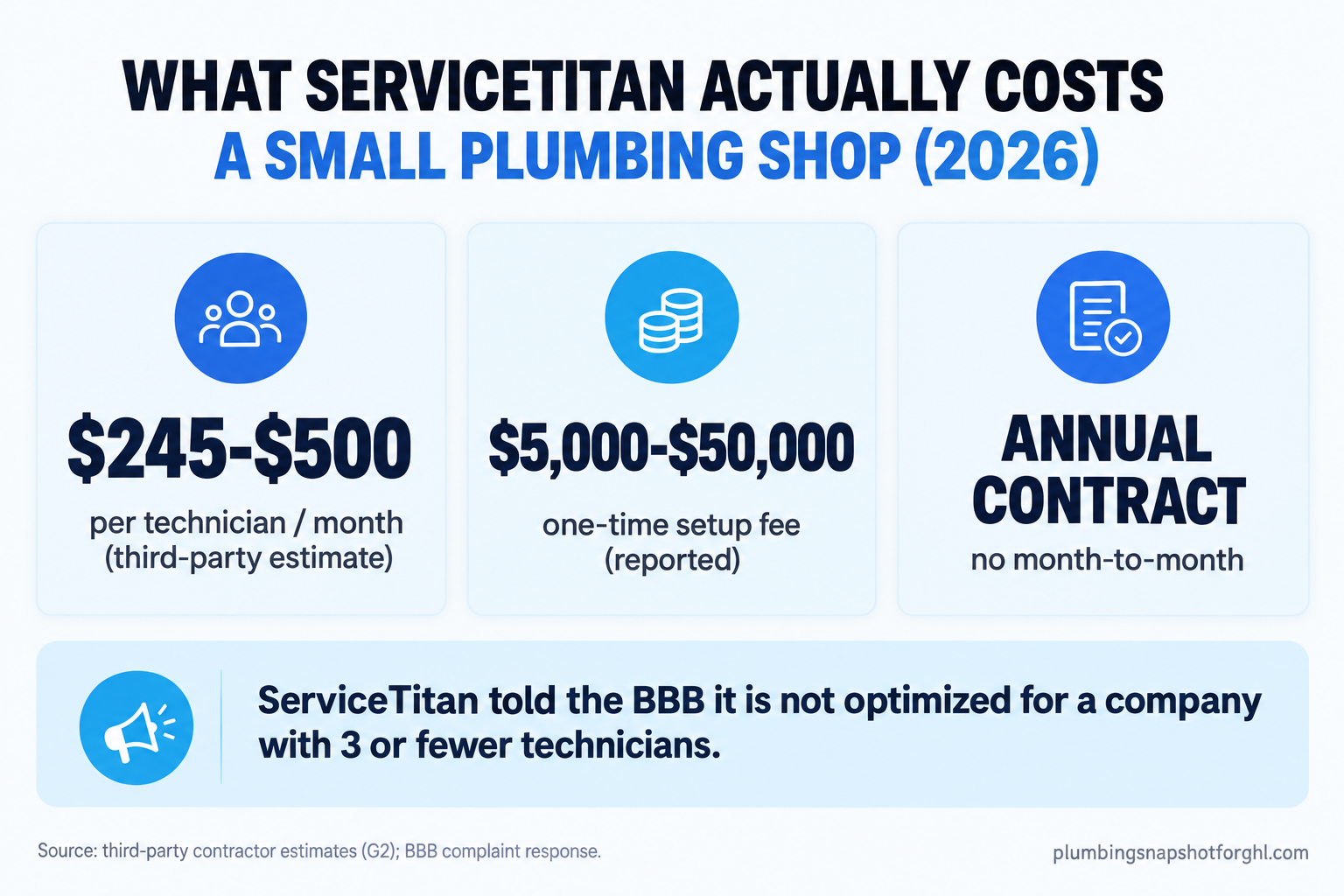
It’s a slow Tuesday and you finally have twenty minutes to price the software everyone tells you to buy. You open ServiceTitan, click “Pricing,” and get a form. Every tier says “Request a Demo.” No number anywhere. So you fill it out, and now a rep is calling your cell while you’re under a sink. Here’s the short version so you can skip that call: ServiceTitan does not publish prices because the answer is “a lot.” Third-party estimates put it at roughly $245 to $500 per technician per month, plus a one-time setup fee reported between $5,000 and $50,000, on an annual contract. And ServiceTitan itself told the Better Business Bureau its platform is not optimized for a company with three or fewer technicians.
In this guide
- Why ServiceTitan won’t show you a price
- What ServiceTitan actually costs in 2026
- The fees nobody quotes on the demo
- The line ServiceTitan put in writing
- What it really costs a solo, a 3-truck, and an 8-truck shop
- How ServiceTitan breaks for a small shop
- The 8 questions that force a straight quote
- What to run instead if you’re under 15 trucks
- Objections, answered straight
- Frequently asked questions
Why ServiceTitan won’t show you a price
Start with the thing that should bother you. Housecall Pro, Jobber, and Service Fusion all print their prices on a public page, so you can budget your software in ten minutes. ServiceTitan makes you request a demo for every tier, and there’s a reason for that.
When a vendor hides the number, the number is high and it is negotiated. Hidden pricing lets a rep read your shop first, size up how many trucks you run and how much you can pay, and quote to that. It also keeps the sticker off Google, so you never see it next to a $79 competitor and flinch. That’s not unusual for enterprise software. It’s just a signal, and the signal is that you’re not the customer they built the pricing page for.
For a shop running one to eight trucks, that matters. You don’t have a procurement team or a software budget line. You have a truck, a phone, and a crew, and every dollar of overhead comes off your take-home. So before you sit through a 45-minute demo, it’s worth knowing roughly what you’d be quoted and whether the tool is even built for a shop your size.
What ServiceTitan actually costs in 2026
ServiceTitan sells three packages: Starter, Essentials, and The Works. None carry a public price, and the model is per technician: you pay for every seat that touches the software (ServiceTitan pricing).
Because ServiceTitan hides the number, the only figures available are what contractors report after they’ve signed. Across the review sites and forums that collect these, the estimates cluster tightly: roughly $245 to $500 per technician per month, with Starter near the bottom and The Works near the top (G2 pricing estimates). Treat that as a directional range, not a published rate. ServiceTitan doesn’t confirm it, and your quote depends on your headcount and what the rep thinks you’ll pay.
The key word is per technician. The cost is not one line item. It’s a line item times your crew, and it grows every time you hire.
Sources: third-party contractor estimates via G2; ServiceTitan does not publish prices. “20+” reflects industry characterization of the BBB statement below.
That per-head tax matters because headcount is already your biggest cost. The median plumber earned $63,800 a year as of May 2025, and skilled techs are hard to find (BLS). A tool that charges you more every time you hire one fights against the growth you’re paying it to support.
The fees nobody quotes on the demo
The monthly per-tech number is only the part they’ll eventually say out loud. Two more costs sit underneath it, and both hit hardest for a small shop.
Implementation. ServiceTitan is a full operating platform, not an app you download and use on Monday. Onboarding means migrating your customer list, building your price book, wiring up phone and dispatch, and training the crew. Contractors report one-time implementation fees from about $5,000 for a small rollout to $25,000 or more for a complex one, running weeks to months (contractor reports via G2). That’s money and time out of the business before the software earns you a dollar.
The contract. ServiceTitan is sold on an annual commitment, not month-to-month, and some customers sign multi-year terms (ServiceTitan service contract FAQ). That’s a real difference from the published-price tools, where you pay monthly and walk if it’s not working. If the fit is wrong in month three, you’re still paying through month twelve.
To its credit, ServiceTitan publishes an Open Data Pledge promising you can export your data as CSV files, which is more than some competitors offer. But the pledge covers getting your records out. It does not cover the year you’re locked into or the second migration you’ll run to leave.
The line ServiceTitan put in writing
Here is the fact that should settle it for most people reading this. In a response to a Better Business Bureau complaint, ServiceTitan stated that its platform is not optimized for a company with three or fewer technicians (BBB complaints page). Industry write-ups characterize the sweet spot as shops running 20 or more techs.
The vendor is telling you, in writing, that if you run a small shop you’re the wrong customer. That doesn’t make it bad software. It’s powerful, and the roll-ups and big regional shops that run it get real value. The tool was built for a different business than yours, and the price, setup, and contract are all sized for it. When a company tells you their product isn’t for you, believe them before you spend $5,000 finding out the hard way.
What it really costs a solo, a 3-truck, and an 8-truck shop
Numbers in the abstract don’t help. Here’s the per-seat math at three shop sizes, using the low end of the reported estimate ($245/tech) so nobody can say it’s stacked against ServiceTitan. Remember this is subscription only, before the one-time setup fee.
Estimated ServiceTitan monthly subscription at the low reported rate of $245 per technician. The high end ($500/tech) roughly doubles every bar. Setup fee ($5,000–$50,000, one-time) is not included.
Solo operator (1 tech). Roughly $245/month at the low end, before setup, for a platform built for a 20-truck dispatch board you’ll never touch. Housecall Pro Basic is $59/month annual and does everything a solo plumber needs, invoicing and online booking included. Paying four times as much for features you can’t use isn’t a growth investment, it’s a leak.
3-truck shop. About $735/month at $245/tech, and this is the exact shop ServiceTitan named. Add the setup fee and you’ve spent five figures in year one before the software books a job. A 3-truck operation lives and dies on the after-hours call and the unsold estimate, not on the depth of the dispatch engine.
8-truck shop. At $1,960/month low end (and potentially near $4,000 at the high end), ServiceTitan starts to look like a real platform decision rather than an obvious mismatch. You have enough trucks that dispatch complexity is real. Even here, run the math against a flat-rate unlimited-user tool like Service Fusion before you sign, because the per-seat model only gets more expensive from truck nine on.
The pattern is simple. The per-tech model punishes exactly the growth you’re working toward. Every hire that should make you money instead raises your bill.
How ServiceTitan breaks for a small shop
Pricing is only half the story. Here is where the fit actually breaks when a small operation tries to run enterprise software, and what to watch for.
It scales your cost with every hire. On a per-seat platform, the tech who’s supposed to add profit adds cost first. Tools that charge a flat rate for unlimited users do the opposite: your twelfth truck is free. For a shop that plans to grow, per-seat pricing works against the plan.
The setup can stall your office for weeks. A full migration and price-book build is a project, and in a small shop the person running it is usually you or your one office admin, who also answers the phone and dispatches. Contractors routinely report onboarding dragging on far longer than expected. Budget for the disruption, not just the fee.
You pay for a control panel you’ll never fill. ServiceTitan’s depth is built for a shop with dedicated dispatchers, CSRs, and a marketing manager. In a 3-truck shop that’s three roles one person covers from the truck. Most of the platform sits unused while you pay full price for it.
The annual contract removes your exit. If the fit is wrong, you can’t cancel next month. You’re committed for the term, still paying while you shop for a replacement and run a second migration. Month-to-month tools let a bad fit cost you 30 days. ServiceTitan can cost you a year.
None of it answers your phone. ServiceTitan, like every dispatch platform in this category, manages the job after it exists. It does not, by default, answer the 2am burst-pipe call, text the caller back in seconds when you miss it, and book the emergency before they dial the next plumber. That capture layer sits upstream of the software you’re pricing, and for a residential shop it’s where the money actually leaks. Our after-hours AI receptionist playbook and missed-call text-back breakdown show that call flow end to end.
The 8 questions that force a straight quote
If you’re still going to take the demo, don’t let a rep run the meeting. Walk in with these eight questions and write down the answers. They turn a vague pitch into a real number you can compare against a tool that prints its price.
If a rep won’t answer question 1 or 2 with a number, that’s your answer. A tool that publishes its price answered all eight before you asked.
What to run instead if you’re under 15 trucks
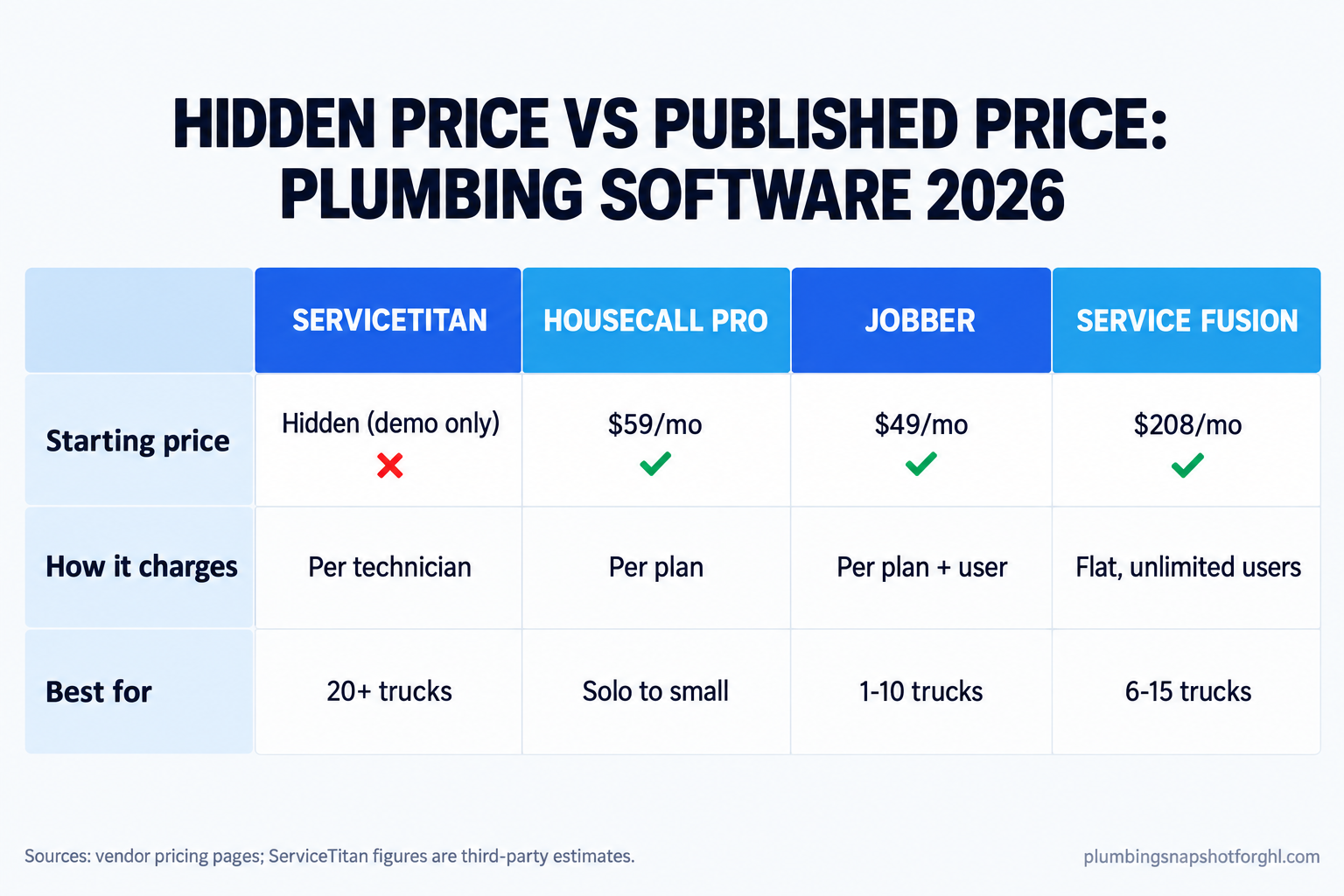
If you run fewer than about 15 trucks, three tools publish their prices and fit a residential shop far better than a platform that says it isn’t built for you.
| Software | Starting price | How it charges | Best for |
|---|---|---|---|
| Housecall Pro | $59/mo (Basic, annual) | Per plan, 1 → 5 → +$35/user | Solo to small crews that want simple |
| Jobber | $49/mo (Core, 1 user) | Per plan + $29/user, add-ons | 1–10 trucks, quoting-heavy shops |
| Service Fusion | $208/mo (Starter, annual) | Flat, unlimited users | 6–15 trucks, growing headcount |
| ServiceTitan | ~$245–$500/tech/mo (est.) | Per technician + setup | 20+ trucks with dedicated office staff |
Sources: Housecall Pro pricing, Jobber pricing, Service Fusion pricing. ServiceTitan figures are third-party estimates.
Housecall Pro runs $59/month (Basic, annual) up to Essentials at $149/month for five users, extra seats around $35 each. It’s the simplest to run and a strong pick for a solo operator or small crew.
Jobber starts at $49/month for Core and adds seats at $29 each, with the tools plumbers often want (Marketing Suite, an AI Receptionist add-on) priced separately. Good fit for quoting-heavy residential work at one to ten trucks.
Service Fusion is the one to weigh if you’re growing. Flat rate for unlimited users, from $208/month annual, no contract. On a per-seat tool your twelfth tech costs the same as your second. On Service Fusion that tech is free, and around six to eight users the flat rate starts beating per-seat pricing outright. For the full six-vendor breakdown with every hidden fee, read what plumbing software actually costs in 2026, and see our head-to-head ServiceTitan comparison for where it fits and where it doesn’t.
Whatever back-office tool you land on, remember that none of them answers the phone after hours. Price the dispatch software for the job it does, then handle call capture and follow-up separately, because that’s the layer that turns marketing spend into booked jobs.
Objections, answered straight
“Everybody in my market runs ServiceTitan. Won’t I fall behind without it?” The shops you’re comparing yourself to are usually the 15-plus-truck outfits and the roll-ups, and yes, that’s their platform. You’re not competing with them on dispatch software. You’re competing on answering the call they let ring out and following up on the estimate they let go cold. A leaner tool plus a real call-capture layer beats an expensive dispatch board you can’t fully staff.
“I already signed with ServiceTitan. Did I make a mistake?” Not necessarily. If you’re at eight-plus trucks and using the depth, it can pencil out. The mistake to avoid is paying enterprise pricing while using it like a $79 tool. If that’s you, run the eight questions above against your renewal before you re-sign for another year.
“Isn’t cheaper software just worse software?” Not here. Housecall Pro and Jobber were built for small shops on purpose, and they’re excellent at it. The hidden-price tools aren’t better for a 3-truck shop, they’re built for a 30-truck one and priced for it. Match the tool to your size, not to the sticker.
“Do I really need any of this, or can I run off my phone and a notebook?” You need something, because the cost of missing calls is real. Water damage and freezing claims average $13,954 and were 27.6% of all homeowners claims in 2022, second only to wind and hail, with about 1 in 60 insured homes filing one a year (Insurance Information Institute). Those are your emergency calls. The question isn’t whether to invest, it’s whether to overpay for a platform that says it isn’t built for you.
Frequently asked questions
How much does ServiceTitan cost per month in 2026?
ServiceTitan does not publish prices. Contractor estimates put it at roughly $245 to $500 per technician per month, plus a one-time implementation fee reported between $5,000 and $50,000, on an annual contract. For a 3-truck shop that's about $735/month at the low end before setup. ServiceTitan told the BBB its platform is not optimized for companies with three or fewer technicians.
Is ServiceTitan worth it for a small plumbing shop?
Usually not under about 8 trucks. ServiceTitan itself stated to the BBB that it is not optimized for companies with three or fewer technicians. Its per-technician pricing scales your cost with every hire, and a small shop rarely uses enough of the platform to justify the price plus the $5,000-plus setup fee. Housecall Pro, Jobber, or Service Fusion fit a 1-to-10-truck shop better.
What are the best ServiceTitan alternatives that publish their prices?
Housecall Pro (from $59/month annual), Jobber (from $49/month), and Service Fusion (from $208/month annual, unlimited users) all print public prices and let you pay monthly. Housecall Pro suits solo and small crews, Jobber suits quoting-heavy shops, and Service Fusion's flat unlimited-user rate wins as you add trucks.
Does ServiceTitan require a long-term contract?
Yes. ServiceTitan is sold on an annual commitment rather than month-to-month, and some customers sign multi-year terms. If the fit is wrong in month three, you typically keep paying through the term. It does publish an Open Data Pledge letting you export your records as CSV files if you leave.
What hidden costs come with ServiceTitan?
Beyond the per-technician subscription, budget for a one-time implementation fee ($5,000 to $50,000 reported), the annual contract commitment, possible renewal increases, payment-processing rates if you take cards through the platform, and the office time to run a multi-week onboarding. Get every one in writing before you sign.
The bottom line
Back on that slow Tuesday, close the demo-request form. You now have what ServiceTitan wouldn’t put on the page: a real per-tech range, the setup fee and contract underneath it, and the vendor’s own written word that the platform isn’t built for a small shop. If you run one to eight trucks, price a tool that publishes its number and lets you pay monthly. Then put your energy into the thing that actually moves revenue: making sure the phone never rings out to a competitor at 2am, because no dispatch board, cheap or expensive, does that for you by default.
About the author
Tyler Brennan is the Compliance and Conversion Editor at Plumbing Snapshot for GHL, based in Columbus, OH. He started in field service marketing writing Google Ads for drain and sewer specialists, then moved into the unglamorous side of automation: keeping SMS and AI messaging compliant while it still converts. He writes about the money side of plumbing software the way he’d brief an owner across the truck bed, plainly, with the numbers and the fine print attached.