

It’s 7:40am, you’ve got a water heater on the truck, and you finally sit down to price the software everyone keeps telling you to buy. You open ServiceTitan: “Request Pricing.” FieldEdge: “Book a Demo.” Workiz: the pricing page 404s. Three tabs, zero prices, and a sales rep about to text you for two weeks. Here is what plumbing field service software actually costs in 2026, vendor by vendor, with the hidden fees, so you can pick one without sitting through a single demo.
In this guide
- Why every vendor hides the price
- What the software really costs you (before you pay a dime)
- The 2026 price list: all six vendors
- ServiceTitan: built for 20 trucks, priced like it
- FieldEdge and Workiz: the ones that won’t show a number
- Housecall Pro vs Jobber: the published-price shops
- Service Fusion: flat rate, unlimited users
- The hidden costs nobody quotes you
- What a solo, a 5-truck, and a 15-truck shop actually pay
- Where the money actually leaks
- Objections, answered straight
- The bottom line
- Frequently asked questions
Why every vendor hides the price
Software pricing gets hidden for one reason: the number is high enough that seeing it cold would send you to a competitor. A demo lets a sales rep anchor you on features, learn your revenue, and quote a price shaped to what they think you’ll pay. That’s not a conspiracy, it’s just enterprise sales. Workiz even used to publish tiered prices and has since pulled them; its old pricing URL now 404s, and its Genius Phone and Answering features are separate add-ons with no listed rate.
The tell is simple. The vendors that make you call (ServiceTitan, FieldEdge, Workiz) are usually more expensive than the ones that print the number on the page. You don’t need the demo. Third-party review sites, user reports, and the vendors’ own published tiers give you enough to build a real budget. Here’s that budget.
What the software really costs you (before you pay a dime)
Before the subscription, understand the money the software is supposed to protect. Plumbing is a phone-and-emergency trade: customers call when they’re standing in water and dial down the list until someone answers. Water damage and freezing claims average $13,954 and were 27.6% of all homeowners claims in 2022, second only to wind and hail (Insurance Information Institute). Software that costs $150 a month is irrelevant if the tool you pick still lets a $7,500 repipe ring out to voicemail at 2am.
The labor side sets the stakes too. The median plumber wage hit $63,800 a year in May 2025, and the top 10% clear $108,420 (BLS). Skilled techs are expensive and hard to find. The point of the software is to keep those techs billable, so judge every price below against that, not against the sticker alone.
The 2026 price list: all six vendors
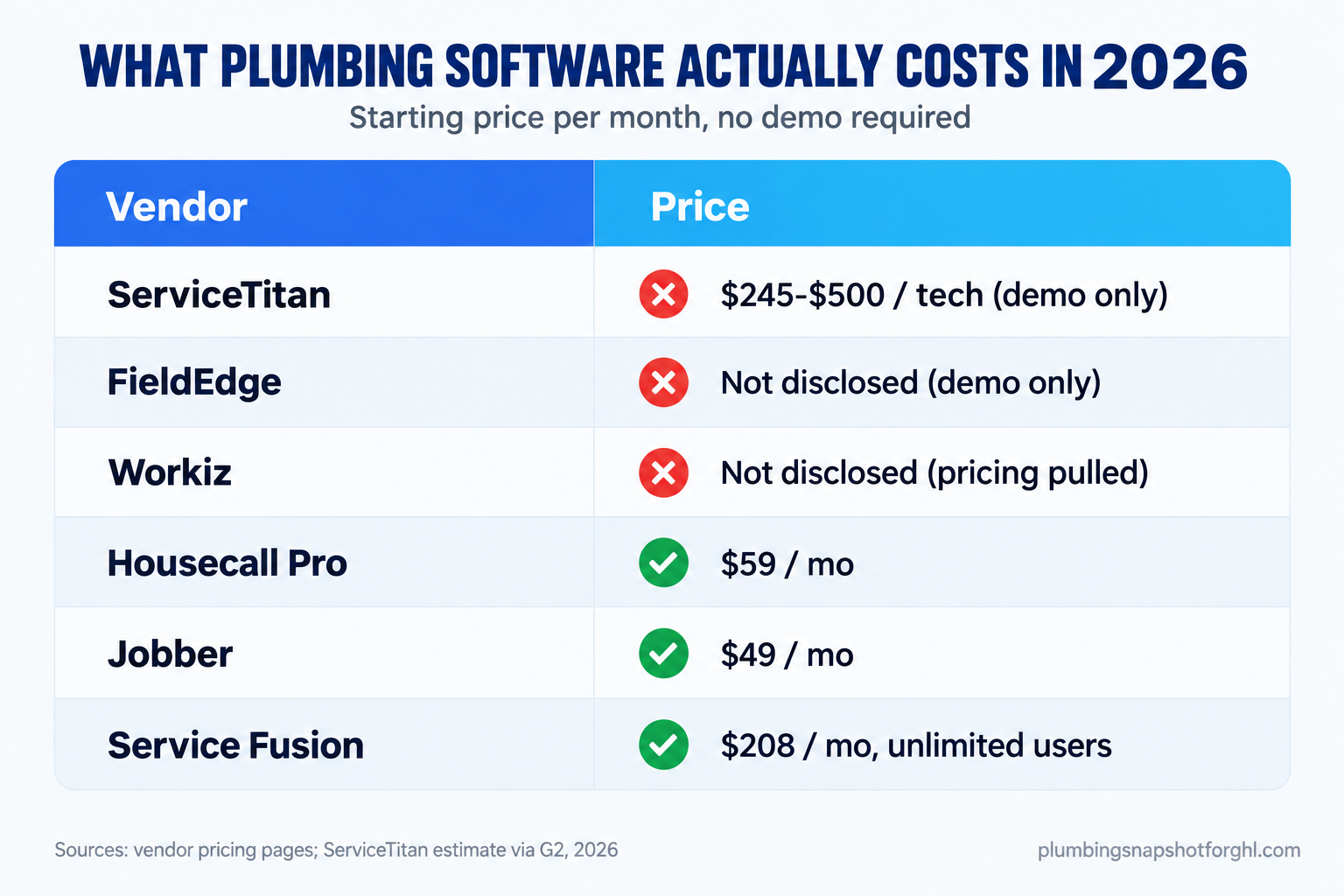
Here is every major platform a residential plumbing shop shops for, with the real starting number and how they charge. Prices are published rates where the vendor prints them, third-party estimates where they hide them.
| Software | Starting price | How it charges | Users included | Price published? |
|---|---|---|---|---|
| ServiceTitan | ~$245–$500 / tech / mo (est.) | Per technician | Per seat | No (demo only) |
| FieldEdge | Not disclosed | Per user (reported) | Per seat | No (demo only) |
| Workiz | Not disclosed (pricing pulled) | Per plan + add-ons | Tiered | No (pulled) |
| Housecall Pro | $59/mo (annual Basic) | Per plan | 1 → up to 5 → +$35/user | Yes |
| Jobber | $49/mo (Core, 1 user) | Per plan + per user | 1 → 5 → 15 | Yes |
| Service Fusion | $208/mo (annual Starter) | Flat, unlimited users | Unlimited | Yes |
Sources: ServiceTitan estimates via G2, Housecall Pro pricing, Jobber pricing, Service Fusion pricing. FieldEdge and Workiz do not publish base rates.
ServiceTitan: built for 20 trucks, priced like it
ServiceTitan is the platform every roll-up and big regional shop runs on, and it’s genuinely powerful. It’s also the clearest “not for a small shop” story in the category. Every tier says “Request Pricing,” and the model is per technician. Third-party estimates put it at roughly $245 to $500 per technician per month, with implementation of $5,000 to $50,000 depending on your data and workflows (G2).
Here’s the fact that should end the conversation for most readers of this site. In a Better Business Bureau response, ServiceTitan stated the platform is not optimized for a company with three or fewer technicians, and works best for shops with 20 or more. That’s the vendor telling you, in writing, that you’re the wrong customer.
How the pricing bites: because it’s per technician, your bill scales with every hire. Add a fourth truck and your software cost jumps another $245–$500 a month, on top of a five-figure setup you already paid. For a 3-truck shop, you’re north of $750/month plus implementation before you’ve booked a single job. Our ServiceTitan breakdown covers where it fits and where it doesn’t.
FieldEdge and Workiz: the ones that won’t show a number
FieldEdge is phone-and-demo only. There is no public price on the site, and reported figures vary widely because every quote is negotiated. What you can say for certain: it charges per user, targets established HVAC and plumbing shops, and you cannot budget for it without a call. Treat “we don’t publish pricing” as a data point, not a mystery.
Workiz moved backwards into opacity. It used to list plans in the low hundreds per month; now the base price is gone and the pricing URL 404s. Worse for a plumber, the features you’d actually want, Genius Phone and its Answering service, are separate add-ons with no listed rate, so any “starting price” you find is not what you’d pay to run the phone properly.
How the pricing bites: the hidden number means you can’t compare apples to apples, and the add-on structure means the demo quote is almost never the quote you pay after you’ve added what you need. When a vendor won’t show a price, budget for the top of the range you find.
Housecall Pro vs Jobber: the published-price shops
These two are where most 1-to-10-truck residential shops land, and both print their prices.
Housecall Pro runs three tiers: Basic at $79/mo ($59 annual, one user), Essentials at $189/mo ($149 annual, up to five users), and Max at $329/mo ($299 annual, one user to start, +$35 per additional user). Basic drops QuickBooks sync and GPS, so most real crews start on Essentials (Housecall Pro).
Jobber runs Core at $49/mo (one user), Connect at $139/mo solo (and $199 at five users), Grow at $199/mo solo (and $299 at five), and Plus starting at $499/mo for five users. Every seat beyond the included count is +$29/mo, and the tools a plumber usually wants are add-ons: Marketing Suite $99/mo, Pipeline $49/mo, and an AI Receptionist at $29/mo (Jobber).
Estimated monthly software cost for a 5-technician shop, annual billing where offered. ServiceTitan bar uses the low end ($245/tech × 5); the high end is roughly double.
How the pricing bites: with Jobber, the sticker is low but the add-ons stack. A Grow plan with the Marketing Suite and a couple of extra users can quietly clear $450/mo. With Housecall Pro, the useful features live in Essentials, so the real entry point for a crew is $149/mo, not $59. Price the plan you’ll actually run, not the headline tier.
Service Fusion: flat rate, unlimited users
Service Fusion is the outlier that matters for growing shops. It charges a flat monthly rate for unlimited users, no contract: Starter $245/mo ($208 annual), Plus $382/mo ($325 annual), and Pro $627/mo ($533 annual) (Service Fusion). GPS fleet tracking and its VoIP phone product sit outside the base price.
That unlimited-user model changes the math as you add trucks. On a per-seat platform, tech number 12 costs the same as tech number 2. On Service Fusion, tech number 12 is free. Somewhere around 6 to 8 users, flat-rate unlimited starts beating per-seat pricing, and by 15 techs it isn’t close.
Estimated monthly software cost for a 15-technician shop. ServiceTitan uses ~$375/tech × 15; Housecall Pro Max = $299 + $35 × 14; Jobber Plus = $499 + $29 × 10.
How the pricing bites: the flat rate is only a deal if you have the headcount to use it. For a solo operator or a two-truck shop, Service Fusion’s Starter at $208/mo is more than you’d pay for Jobber Core or Housecall Pro Basic, and you’re paying for unlimited seats you don’t have. It’s a scale play, not a starter play.
The hidden costs nobody quotes you
The subscription is the number they show you. These are the ones they don’t, and they routinely double the real cost of the “cheap” plan.
- Implementation and onboarding. ServiceTitan’s $5,000–$50,000 setup is the extreme, but even mid-market tools charge for data migration and training. Ask for the one-time cost in writing.
- Per-user creep. Housecall Pro’s +$35/user and Jobber’s +$29/user are easy to forget when you’re pricing the base plan. Multiply by your real crew size, then by 12 months.
- Payment processing. Most of these tools push you onto their card processor at roughly 2.6%–2.9% + $0.30 per transaction. On $1M in card volume, a half-point difference is $5,000 a year.
- Add-ons for the phone. The features that actually book jobs, AI answering, two-way texting, marketing, are frequently add-ons (Jobber’s Receptionist, Marketing Suite, Pipeline; Workiz’s Genius Phone). Price those in.
- Contracts and data export. Ask whether you’re locked into an annual term and what it costs to export your customer list if you leave. A tool you can’t leave cheaply isn’t as cheap as it looks.
What a solo, a 5-truck, and a 15-truck shop actually pay
The right pick changes with your headcount. Run the same framework at three sizes.
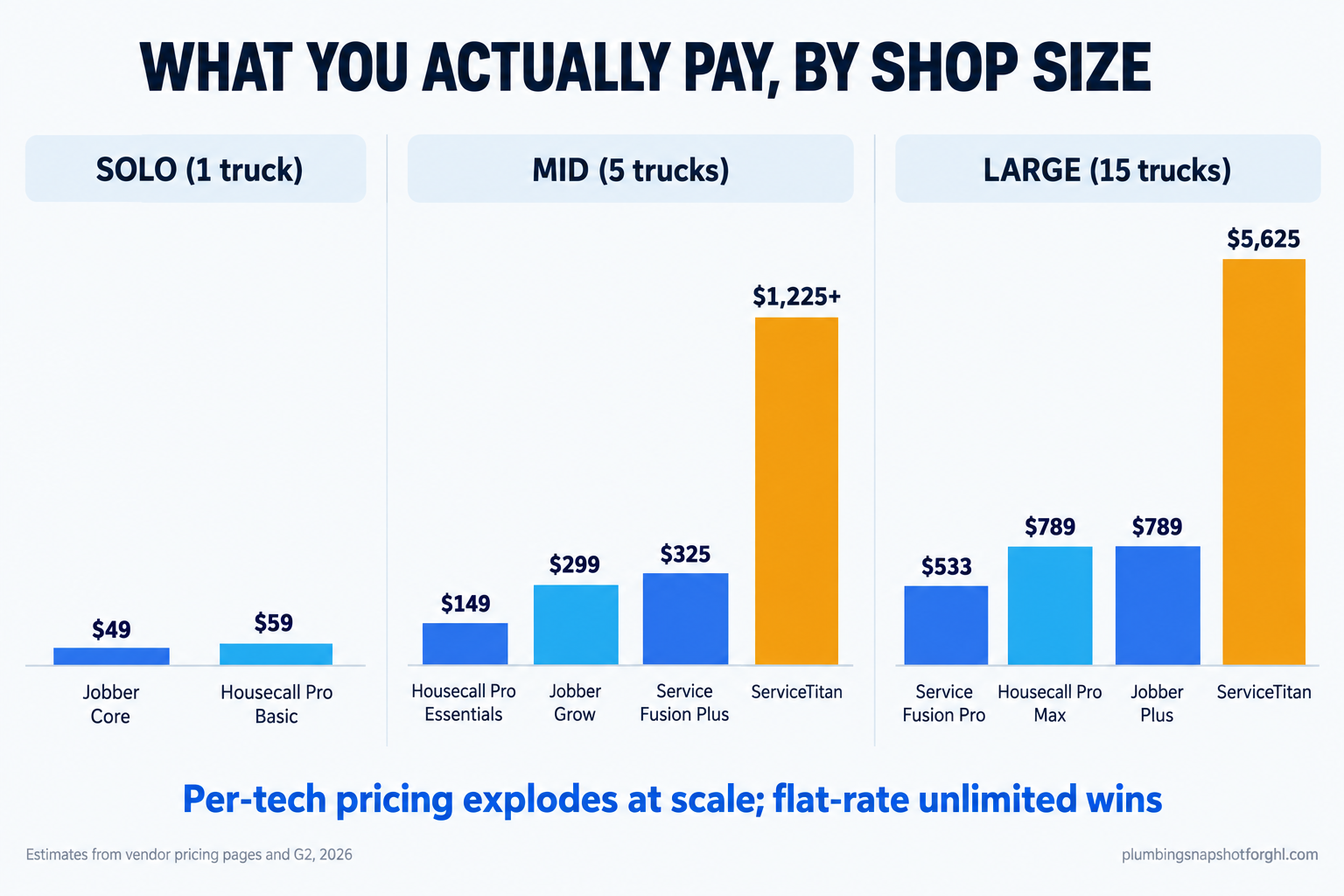
Solo operator (1 truck, owner runs everything). You want the lowest sticker with real scheduling, invoicing, and online booking. Jobber Core at $49/mo or Housecall Pro Basic at $59/mo are the honest answers. ServiceTitan has told you you’re the wrong fit, and Service Fusion’s unlimited seats are wasted on a crew of one. Total: under $60/month.
Mid-size shop (5 trucks, office manager, dispatch). Now you need multiple seats, GPS, and QuickBooks sync. Housecall Pro Essentials at $149/mo (five users included) is the value pick; Jobber Grow lands around $299/mo at five users; Service Fusion Plus is about $325/mo for unlimited. ServiceTitan at five techs is roughly $1,225–$2,500/mo plus implementation, real money for features a five-truck shop won’t fully use. Total: $149–$325/month for the sensible options.
Large shop (15 trucks, multiple CSRs). This is where flat-rate unlimited wins. Service Fusion Pro at ~$533/mo covers all 15 seats. Per-seat tools climb: Housecall Pro Max lands near $789/mo (base plus 14 users), Jobber Plus near $789/mo the same way. ServiceTitan at 15 techs is roughly $5,625/mo at a $375/tech midpoint, where its enterprise features finally start earning it. Total: $533–$5,600+/month.
The pattern is clean: published-price starter tools win for small shops, flat-rate unlimited wins in the middle-to-large range, and per-technician enterprise pricing only makes sense once you’re genuinely running an enterprise.
Where the money actually leaks
Here’s the part the pricing pages won’t tell you. For a residential plumbing shop, the dispatch board is not where you’re losing money. The phone is. You can run the best-priced field service software on the market and still bleed jobs, because none of these tools, by default, answers the 2am burst-pipe call, texts the caller back in seconds when you miss it, and books the emergency before they dial the next plumber. That capture layer sits upstream of the software you just priced, and it’s what turns marketing spend into booked revenue.
That’s the gap our system closes, and it runs on GoHighLevel rather than a per-tech dispatch platform, so the cost is flat instead of climbing with every hire. The Plumbing Snapshot wires up the after-hours AI receptionist, missed-call text-back, two-way SMS, and review automation as one pre-built system. It doesn’t replace your invoicing tool; it plugs the leak no invoicing tool was built to plug. Our after-hours AI receptionist playbook and missed-call text-back breakdown show the call flow end to end.
Objections, answered straight
“I already pay for ServiceTitan (or Housecall Pro). Isn’t this redundant?” No. Those platforms handle dispatch, invoicing, and the job record. The Snapshot handles the call capture and follow-up before a job exists and after it closes. Plenty of shops run both: the dispatch platform for the back office, the automation layer for the phone and reviews. Different jobs.
“Isn’t cheaper software just worse software?” Not in this category. Housecall Pro and Jobber built for small shops on purpose, and they’re excellent at it. The expensive, hidden-price tools aren’t better for a 3-truck shop, they’re built for a 30-truck one and priced accordingly. Match the tool to your size, not to the sticker.
“Do I need to be technical to switch tools?” No, but budget time, not just money. Every migration means moving your customer list, rebuilding your price book, and training the crew. That’s why the implementation-fee and data-export questions on the checklist above matter as much as the monthly rate.
“Why not just use my current tool’s built-in phone features?” You can, and you should price them honestly. Jobber’s AI Receptionist is a $29/mo add-on; Workiz’s Genius Phone is unpriced. Add-on phone tools are often thinner than a purpose-built call-capture system, and they meter or gate the exact feature, after-hours answering, that books your biggest jobs. Read the answering service cost breakdown before you assume the built-in option is the cheap one.
Frequently asked questions
What does ServiceTitan cost per month in 2026?
ServiceTitan doesn't publish prices. Third-party estimates put it at roughly $245 to $500 per technician per month, plus a one-time implementation fee of $5,000 to $50,000 (G2). For a 3-truck shop that's north of $750/month before implementation, and ServiceTitan has told the BBB its platform is not optimized for companies with three or fewer technicians.
What's the cheapest field service software for a solo plumber?
Jobber Core at $49/month and Housecall Pro Basic at $59/month (annual) are the cheapest real options with scheduling, invoicing, and online booking, and both publish their prices. ServiceTitan (built for 20+ techs) and Service Fusion (unlimited-user pricing) are poor fits for a crew of one.
Is Housecall Pro or Jobber cheaper for a 5-technician plumbing shop?
Housecall Pro is usually cheaper at five techs: Essentials is $149/month annual and includes five users. Jobber Grow lands around $299/month at five users because extra seats cost $29 each and the tools plumbers want (Marketing Suite, Pipeline, AI Receptionist) are separate add-ons.
Why does Service Fusion charge a flat rate instead of per user?
Service Fusion bundles unlimited users into every plan ($208–$533/month annual, no contract). On a per-seat tool, tech number 12 costs the same as tech number 2; on Service Fusion it's free. The break-even against per-seat pricing is roughly 6 to 8 users, and by 15 techs flat-rate is far cheaper.
What hidden costs should I ask about before buying plumbing software?
Five things routinely double the real cost: implementation fees, per-user charges above the included count, card processing rates (about 2.6%–2.9% + $0.30 per transaction), add-ons for phone and marketing features, and annual contracts with data-export fees if you leave. Get every one in writing before you sign.
The bottom line
Back at 7:40am with the water heater on the truck: close the three tabs full of “Request Pricing” buttons. You now have the real numbers, the hidden fees, and the nine questions that force a rep to quote straight. Pick the tool that fits your truck count, solo shops on Jobber Core or Housecall Pro Basic, mid-size on Housecall Pro Essentials or Service Fusion, large crews on flat-rate unlimited. Then spend your energy on the thing that actually moves revenue: making sure the phone never rings out to a competitor at 2am.
About the author
Hector Salinas is the GHL Automation Lead at Plumbing Snapshot for GHL, based in Phoenix, AZ. He spent nine years dispatching for a 12-truck plumbing operation before he ever touched a CRM, and he writes about after-hours call flows, emergency dispatch, and the revenue math behind plumbing automation the way he’d brief a new service manager: plainly, with the numbers attached.