
For most Orlando plumbing shops the real decision isn’t “Wix or a custom site” — it’s “build and maintain it yourself, or have a fast, done-for-you site built and managed for you.” Wix is genuinely good at what it is: a cheap, drag-and-drop builder you can start this afternoon, and its speed has improved to where 58.7% of Wix sites now pass Google’s Core Web Vitals versus 39.0% of WordPress sites (Search Engine Journal, citing Google CrUX). But a plumbing website has a specific job — win the stressed homeowner searching on a phone, rank for every town you roll a truck to, and feed the AI answer engines now sitting on top of Google. This guide compares Wix against a custom build on the four things that decide whether a plumbing site pays for itself: speed, SEO/AEO, per-city pages, and total cost — honestly, including where Wix is the right call.
In this guide
- The real question: DIY builder vs done-for-you
- Speed: where Wix is fine, and where the ceiling is
- SEO & AEO: the control gap that costs Orlando plumbers ranking
- City pages: the feature Orlando plumbers need most
- Cost: the sticker price vs the real cost
- Wix vs a custom build: side by side
- When Wix is actually the right call
- What a done-for-you custom build looks like
- Frequently asked questions
- About the author
- Related reading
The real question: DIY builder vs done-for-you
Most “Wix vs custom” debates argue about the wrong thing. Wix isn’t bad software — it’s a capable drag-and-drop builder, and if you enjoy tinkering you can stand up a decent-looking page in a weekend. The question that actually matters to a plumbing shop is different: who builds it, who keeps it fast and current, and does its structure win the searches that pay you?
With Wix, the answer is you. You choose the template, you write the pages, you compress the images, you add the plugins, and when your after-hours rate changes you log back in and edit it yourself — assuming you remember how. That’s fine for a hobby site. For a business where the phone ringing at 11 PM is a water-heater replacement, “I’ll get to the website this weekend” is how the site quietly falls three price rises out of date and stops ranking.
The Wix demo always looks great in the showroom. The problem shows up six months later, when the owner is on a truck 50 hours a week and the site hasn’t been touched since launch — no new city pages, no schema, an old price, and a competitor’s done-for-you site quietly eating the map pack.
A custom, done-for-you site flips the ownership: the build, the speed, the city pages, the schema, and the edits are somebody’s job — not a task competing with running the shop. That’s the frame for everything below.
Speed: where Wix is fine, and where the ceiling is
Let’s give Wix its due first, because the old “Wix is slow” reputation is out of date. Google’s own Chrome User Experience data shows Wix has improved sharply: as of January 2024, 58.7% of Wix sites passed all three Core Web Vitals, compared with 39.0% of WordPress sites (Search Engine Journal, citing CrUX). If your only alternative were a plugin-heavy WordPress build, a modern Wix site would often load faster.
But “faster than WordPress” and “fast enough to win the job” are different bars. Speed is where plumbing leads live or die, and the data is blunt:
- Google found 53% of visits to a mobile site are abandoned if the page takes longer than 3 seconds to load (Think with Google).
- As mobile load time grows from 1 second, the probability a visitor bounces rises steeply — +32% by 3 seconds, +90% by 5 seconds, and +106% by 6 seconds (Think with Google).
Increase in the probability a mobile visitor bounces as page load time grows from 1 second. Source: Think with Google.
Now the money side. Portent’s analysis of tens of millions of page views found a site loading in 1 second converts roughly 3× better than one loading in 5 seconds, with conversions highest in the 0–4 second band (Portent). And the gains show up at tiny margins: in Deloitte’s “Milliseconds Make Millions” study with Google, a 0.1-second improvement in mobile load time lifted retail conversions 8.4% (Deloitte / web.dev).
Here’s the ceiling. Wix builds every page in the browser from a hosted app, so your speed depends on which template, apps, and widgets you bolt on — and “passing” Core Web Vitals only means clearing Google’s minimum thresholds (LCP ≤ 2.5s, INP ≤ 200ms, CLS ≤ 0.1) at the 75th percentile. Passing is not the same as fast: across the whole web, only about 43% of mobile sites pass all three (HTTP Archive Web Almanac 2024), so clearing the bar is an edge — but it’s a floor, not a finish line. A custom static build takes a different route: pages are pre-built and served as plain HTML from an edge network, which is why frameworks like Astro routinely hit a guaranteed 90+ PageSpeed, often a clean 100 — the difference between “good enough for Google” and “opens before the homeowner loses patience.” We break the platform mechanics down in Astro vs. WordPress for plumber websites and the full speed math in is a slow website costing plumbers jobs.
SEO & AEO: the control gap that costs Orlando plumbers ranking
Speed gets the tap. Structure gets the ranking — and this is where a plumbing shop feels the difference between a builder and a custom build most.
Ranking for “water heater repair Orlando” or “drain cleaning Winter Park” isn’t about one homepage. It’s about clean technical SEO on every page: unique titles and meta, correct heading structure, fast mobile rendering, an accurate sitemap and robots file, and — increasingly — structured data (schema) so Google understands you’re a local plumbing business serving specific areas. Wix has closed a lot of its old SEO gaps, but it’s still a walled garden: you work within what the builder exposes, custom code is capped or awkward, and controlling schema, redirects, and page-level markup at scale is a fight rather than a default.
Then there’s the newer battleground: AI answer engines. About one in five Google searches in March 2025 returned an AI-generated summary, and 58% of users saw at least one (Pew Research Center). When a homeowner asks ChatGPT, Perplexity, or Google’s AI Overview “who fixes a burst pipe in Orlando,” the tools pull from structured, machine-readable pages. That means clean schema and an llms.txt file describing what you do and where — exactly the kind of technical detail a DIY builder buries and a custom build ships on every page. We cover this shift in AI search for plumbers and the fundamentals in local SEO for plumbers.
City pages: the feature Orlando plumbers need most
If there is one feature that separates a plumbing website that ranks from one that just exists, it’s a real, individually written page for every town you serve — College Park, Winter Park, Baldwin Park, Lake Nona, Kissimmee, Winter Garden — each with its own title, its own schema, and its own internal links. That is what decides whether you appear for “sewer line repair Winter Garden” or whether the franchise across town takes it.
Building that in Wix means hand-creating and maintaining a dozen near-identical pages by drag-and-drop, keeping each one’s SEO tags straight, and never letting them collapse into thin, duplicate content — a genuine chore that most owners start and abandon. A custom build treats city pages as a system: written per town, structured consistently, and expandable as your service radius grows, without you touching the code.
Orlando makes this matter more than most markets. The city has roughly 319,758 residents but only a 39.5% homeownership rate — well below the national average — with a median owner-occupied home value near $394,100 (up 9.8% year over year) and a median household income around $72,336 (Data USA / U.S. Census ACS). Translation: the homeowners and property managers worth winning are a competitive minority spread across a sprawling metro of vacation rentals and managed properties. You win them town by town, on a fast page that ranks — not on a single “service areas” list buried three clicks deep.
Cost: the sticker price vs the real cost
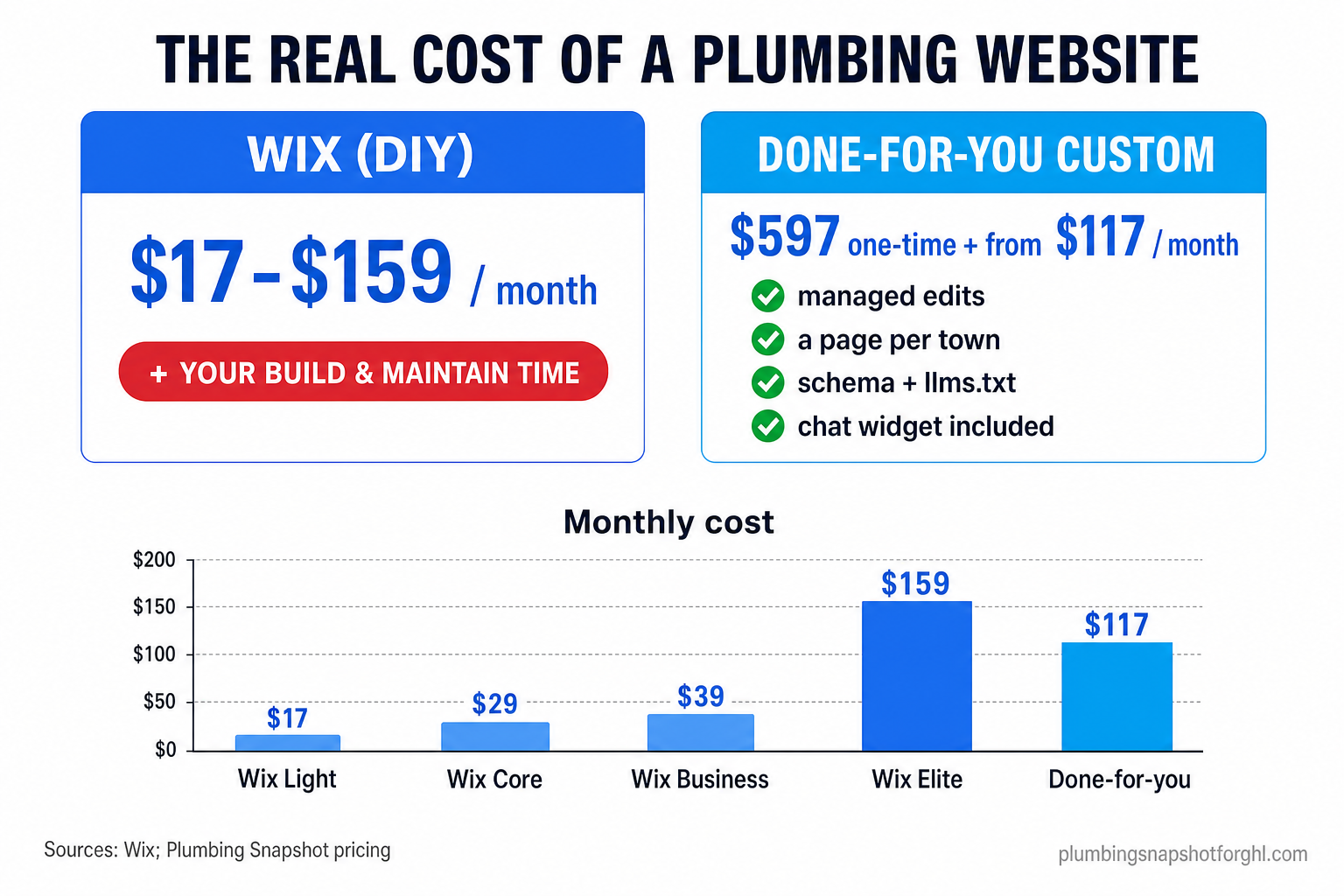
On the sticker price, Wix wins — and it’s not close. Wix’s paid plans run roughly $17 to $159 per month billed annually (Light, Core, Business, and Business Elite tiers) (Wix). For under $40 a month you get hosting, a domain, and a template. That’s the appeal, and it’s real.
But the sticker price isn’t the cost. The cost is the sticker price plus your time — and your time is the single most expensive thing in a plumbing shop. Every hour you spend fighting a template, compressing an image, or trying to add a city page is an hour off a truck or off the phone. And the “cheap” site has a way of staying half-finished: no schema, no llms.txt, three city pages instead of twelve, and a price that’s out of date because editing it dropped down the to-do list months ago.
A done-for-you custom build reframes the math. Our plumbing website is $597 one-time plus from $117/month, and that monthly covers managed hosting, SSL, the domain, ongoing edits, a page per town, schema/AEO markup, and a built-in chat widget and review automation — the whole checklist, kept current, with no hours of your own spent on it. Compared with a freelance custom build (commonly $2,000–$8,000 up front, then you own the maintenance), it’s the done-for-you middle path: custom-grade structure without the DIY time sink or the big agency invoice.
Approximate monthly cost by option (USD). Wix plans billed annually; the done-for-you build also includes a one-time $597 setup plus managed edits, city pages, schema and a chat widget. Sources: Wix; Plumbing Snapshot pricing.
Wix vs a custom build: side by side
Here’s the honest head-to-head — what each option actually gives an Orlando plumbing shop.
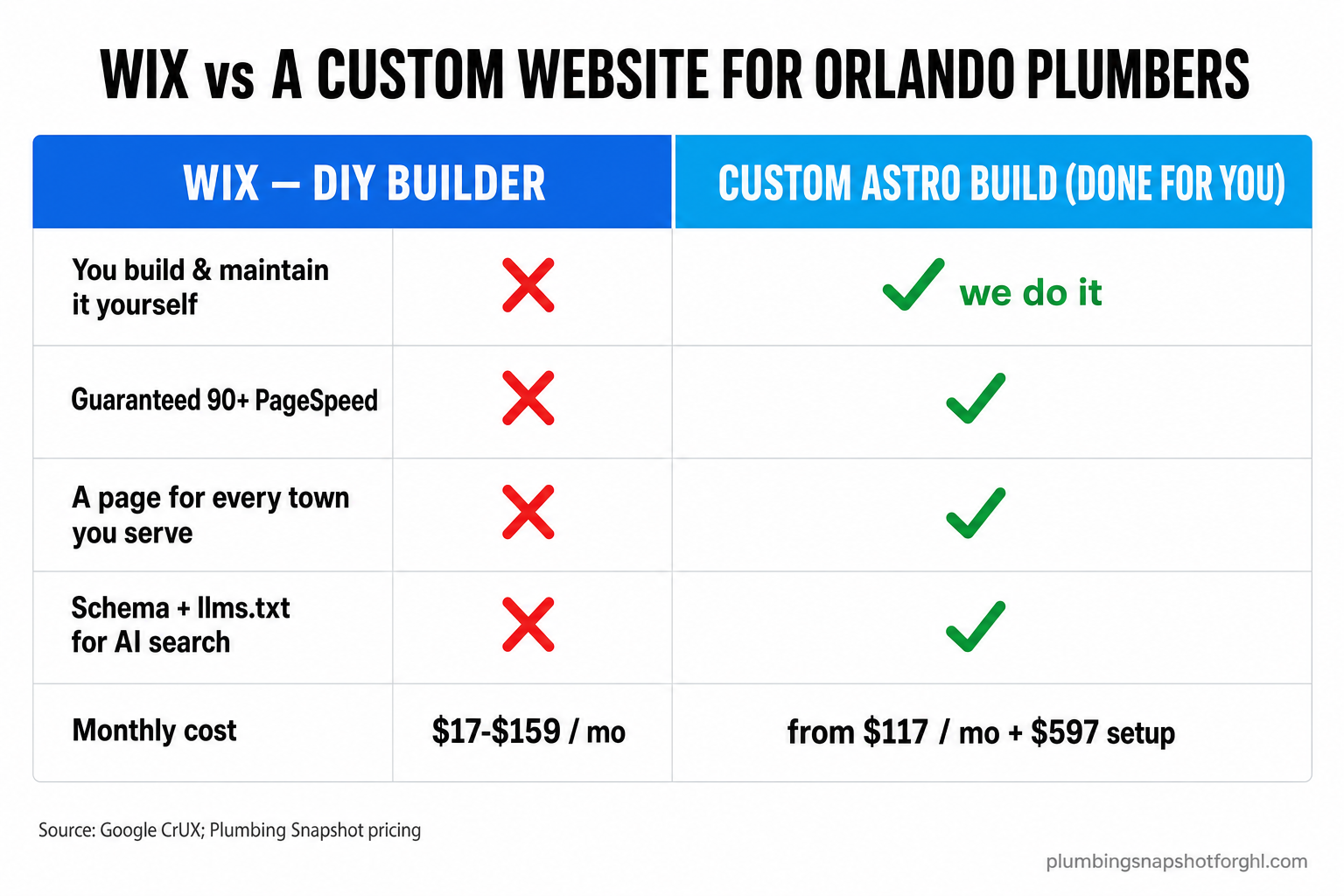
| What matters for a plumbing site | Wix (DIY builder) | Done-for-you custom build |
|---|---|---|
| Who builds & maintains it | You do — every page and edit | We do — managed, ongoing |
| Page speed | Reasonable; ~58.7% of Wix sites pass CWV | Guaranteed 90+ PageSpeed, often 100 |
| Core Web Vitals | “Passing” is the goal (a floor) | Built to clear the bar with margin |
| Pages per town you serve | Hand-built, drag-and-drop, easily abandoned | Written per city, structured as a system |
| Schema, AEO & llms.txt | Capped / awkward | Shipped on every page |
| Custom code & integrations | Limited by the builder | Full — GHL, ServiceTitan, Jobber, Zapier |
| Editing your after-hours rate | You log in and do it | A revision request, done for you |
| Chat widget & review automation | Paid apps, bolted on | Included on every plan |
| Monthly cost | ~$17–$159/mo (you supply the labor) | From $117/mo (labor included) + $597 setup |
| Who owns the outcome | You | Us |
The pattern is consistent: Wix moves the cost to your time and leaves the growth features half-built; the done-for-you column moves the work off your plate for a predictable monthly number. That’s the whole argument — not that Wix can’t make a page, but that you shouldn’t have to become your own web developer, SEO, and IT department to get the phone ringing.
When Wix is actually the right call
Being honest cuts both ways. Wix is genuinely the better choice in a few cases, and pretending otherwise would be the SaaS hype this brand avoids:
- You’re pre-revenue or testing. If you’re a brand-new one-person shop just validating that plumbing pays in your area, a $29/month Wix page you build yourself is a sensible, low-risk start.
- You truly enjoy building it and have the time. Some owners like the control and genuinely keep it current. If that’s you, Wix is fine.
- You need one simple page, today, and rank isn’t the goal. If the site is just a digital business card and your leads come entirely from referrals, a builder is enough.
Where Wix stops being the right call is the moment the website becomes a lead channel you can’t afford to lose — when you’re paying for Google Ads or LSAs, competing in a metro like Orlando, and every slow or unstructured page is a booked job walking to a faster competitor. That’s the line where done-for-you pays for itself.
What a done-for-you custom build looks like
A custom plumbing site in 2026 isn’t a bespoke six-figure project — it’s a productized, done-for-you build on fast architecture:
- Static-first speed. Built on Astro, served from Cloudflare’s edge, with a guaranteed 90+ PageSpeed on mobile and desktop — not “passing,” fast.
- A page for every town you roll to. Individually written city and neighborhood pages across metro Orlando, each with its own schema and internal links.
- Structured for Google and AI. Schema, clean meta, sitemap/robots, and an llms.txt file on every page, so both the map pack and the AI answer engines can read what you do.
- Capture built in. A sticky call bar, a short emergency form, a chat widget, and review automation wired from day one — see the AI chat widget for plumbers and online booking.
- Managed, not handed over. Rate changes, new city pages, and fixes are a revision request, done for you in a few working days — not a weekend project you keep postponing.
Frequently asked questions
Is Wix good enough for a plumbing website?
For a brand-new or one-person shop testing the waters, yes — Wix is cheap, easy, and modern Wix sites are reasonably fast (about 58.7% pass Google's Core Web Vitals, better than WordPress at 39.0%). Where it falls short for a growing plumbing business is control: hand-built city pages that get abandoned, capped custom code, and limited schema and llms.txt for AI search. Once your website is a lead channel you can't afford to lose, a done-for-you custom build usually pays for itself.
Is Wix or a custom website faster?
A modern Wix site is often faster than a plugin-heavy WordPress build, but 'passing' Core Web Vitals only means clearing Google's minimum thresholds. A custom static build on a framework like Astro is pre-rendered and served from an edge network, which is why it targets a guaranteed 90+ PageSpeed score — meaningfully faster than a typical builder page, and speed is what keeps the stressed homeowner from bouncing (53% abandon a page that takes over 3 seconds).
Can you rank on Google with a Wix site in Orlando?
You can, but it's harder to do well at scale. Ranking for Orlando-area searches means a fast, individually optimized page for each town you serve, clean schema, and correct technical SEO on every page. Wix has improved its SEO tools but remains a walled garden — controlling per-page markup and city pages is a manual chore. A custom build treats city pages and schema as a system, which is what wins competitive local searches like 'water heater repair Winter Park.'
How much does a custom plumbing website cost vs Wix?
Wix's paid plans run about $17 to $159 per month (billed annually), but you supply all the labor. A freelance custom build is commonly $2,000–$8,000 up front, then you own the maintenance. Our done-for-you build is the middle path: $597 one-time plus from $117/month, with managed hosting, ongoing edits, city pages, schema, and a chat widget included — custom-grade structure without the DIY time or the big agency invoice.
Why do city pages matter so much for an Orlando plumber?
Because local search is won town by town. A homeowner searches 'drain cleaning Winter Garden,' not just 'plumber' — and the shop with a real, optimized page for that town tends to win it. Orlando is a large, competitive metro with a low homeownership rate (39.5%), so the owners and property managers worth winning are spread across many neighborhoods. Individually written, schema-backed city pages are how you appear across the whole service radius instead of just your home ZIP.
Will switching from Wix to a custom site hurt my Google rankings?
Done properly, a migration to a faster, better-structured site helps rankings rather than hurting them — as long as URLs are mapped, 301 redirects are set, and content and schema are preserved. A fast custom site with proper city pages and clean sitemap/robots/llms files typically holds its rankings through the switch and improves within a few months. The risk comes from rushed migrations that skip redirects, which is exactly what a managed, done-for-you build avoids.
About the author
Tyler Brennan is the Compliance & Conversion Editor for Plumbing Snapshot for GHL, based in Columbus, OH. He started in field-service marketing writing Google Ads for drain and sewer specialists, then moved into the unglamorous work of making the page the ad points to actually convert — including the speed, structure, and technical SEO most contractors never audit. He writes checklists a busy plumbing operator can actually follow, with the revenue math attached.
Related reading
- Astro vs. WordPress for Plumber Websites — the platform decision behind a fast, custom build.
- Is a Slow Website Costing Plumbers Jobs? — the full page-speed and Core Web Vitals math.
- Local SEO for Plumbers — how city pages and structure win the map pack.
- AI Search for Plumbers — why schema and llms.txt now decide who AI engines quote.
- AI Chat Widget for Plumbers — capture the fast-loading visitor before they leave.
- Online Booking for Plumbers — the self-scheduling flow a fast page books into.
- The Done-For-You Plumbing Website — a guaranteed 90+ PageSpeed Astro site, built and maintained for you.